Syracuse
Today’s journey takes us through some of the richest layers of Sicilian history — from the power and ambition of the ancient Greek world, to the vibrant daily life of modern Sicily, to the elegant golden-stone beauty of Sicilian Baroque architecture. Few places in Europe contain so many civilizations, eras, and atmospheres within a single day’s drive.
We begin in Syracuse, once one of the most important cities in the ancient Mediterranean. Founded by Greek settlers in 734 BC, Syracuse grew into a wealthy and powerful city-state that rivaled Athens itself. At its height, it was one of the largest cities in the world. Philosophers, mathematicians, playwrights, and politicians all passed through here, including the famous scientist Archimedes, who was born in Syracuse and later killed during the Roman conquest of the city.
Neapolis Archaeological Park
The Neapolis Archaeological Park is one of the most important archaeological sites in all of Italy. Walking through it is like moving through different chapters of ancient history at once.
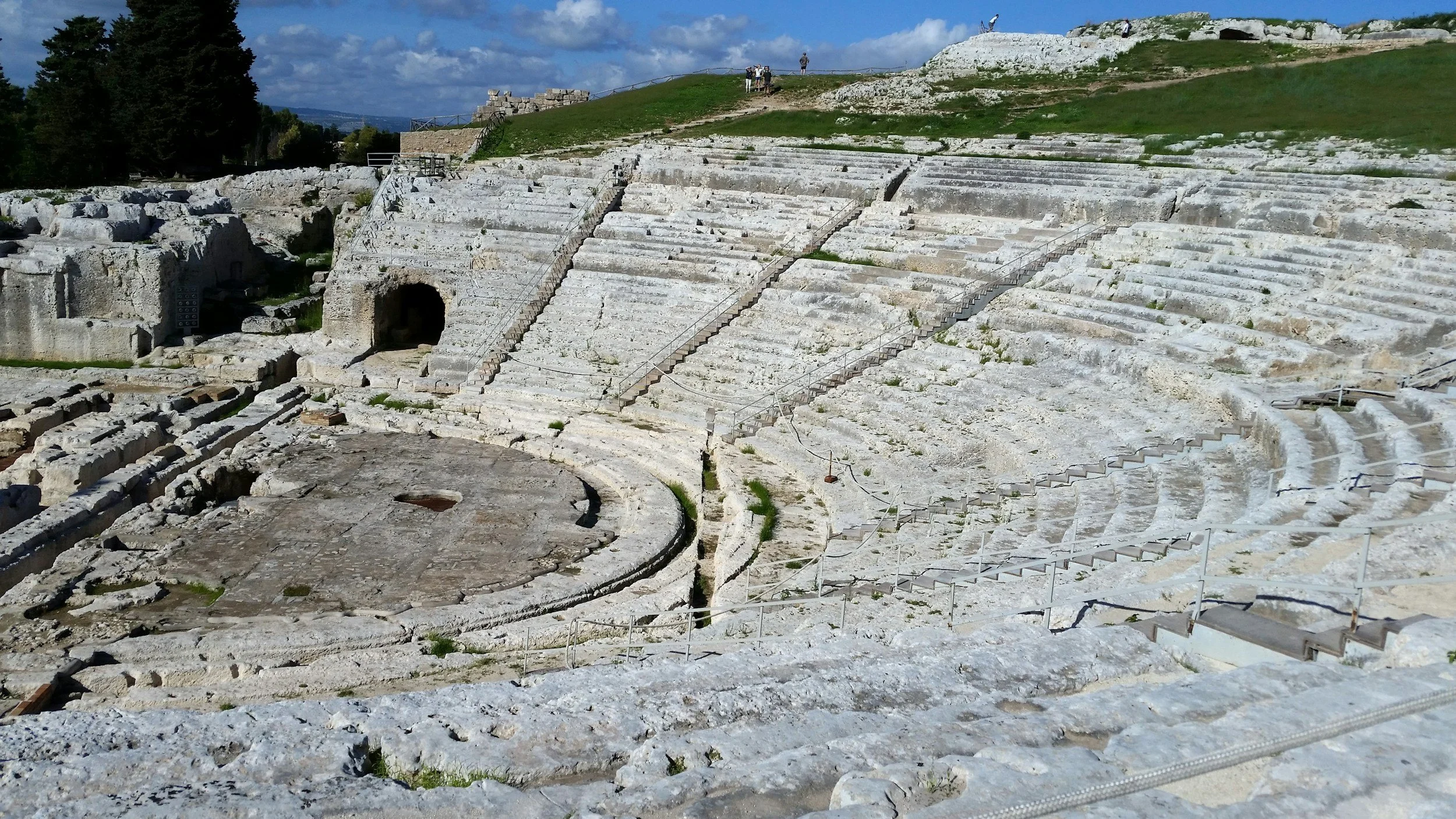
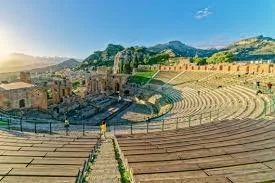
Greek Theatre of Syracuse
The Greek Theatre of Syracuse was carved directly into the hillside in the 5th century BC and later expanded. It is one of the largest ancient Greek theatres ever built, capable of holding thousands of spectators.
This was not merely entertainment — theatre in the Greek world was deeply connected to politics, religion, and public life. Dramatic competitions and performances were major civic events. Some of the greatest playwrights of antiquity, including Aeschylus, are believed to have presented works here.
In the Greek age, only men were allowed to act and they played female parts with masks. When the Romans arrived, they made some modifications. They enlarged the stage and made it semi-circular instead of horseshoe shaped. In the late Imperial age, they adapted the arena to put on water games, but it’s unclear whether any gladiatorial games every transpired. Even today, performances are still occasionally held here during the summer months, continuing a tradition that stretches back over two millennia.
Take a moment to notice the scale and acoustics of the theatre. With 67 rows of seats, it had a seating capacity of 15,000 with the seats carved directly into the stone (now there are only 35 rows). Seven staircases lead to the top. Even from the upper seating levels, voices can still carry remarkably well. The setting itself is also extraordinary: Greeks carefully chose locations where theatre, landscape, and nature could blend together into a single experience.
Ear of Dionysius
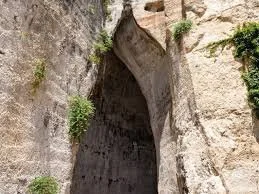
Nearby is one of Syracuse’s most famous and unusual sites: the Ear of Dionysius.
This enormous limestone cave rises roughly 23 meters (75 feet) high and curves inward in the shape of a giant ear. The cave was created through ancient stone quarrying, but its remarkable acoustics made it legendary.
According to tradition, the tyrant Dionysius used the cave as a prison and secretly listened to prisoners from above by taking advantage of the echoing acoustics. Whether the story is fully true or not remains uncertain, but the acoustics are undeniably extraordinary. Even small sounds inside the cave can echo dramatically.
The painter Caravaggio is said to have given the cave its famous name during a visit in the 17th century.
Roman Amphitheater
The Roman Amphitheater of Syracuse reflects the next major chapter of Sicily’s history: Roman rule.
The amphitheater dates from 212 B.C. For the best view, head to the upper level.
The prefix amphi means “on both sides” - while the Greek built their theaters in a single semi-circle, the Romans built two theaters facing each other to have an audience in the round. Moreover - while the Greeks built theaters into existing landscapes, the Roman theaters were freestanding. This amphitheater is approximately 460 feet long and 390 feet wide. There are two large entrances at both ends.
Unlike the Greek theatre, which focused on drama and public performances, Roman amphitheaters were designed for spectacles — gladiator contests, staged hunts, and public entertainment. You can still clearly see the oval shape and the underground sections where machinery, animals, and performers were once prepared before entering the arena.
The contrast between the Greek and Roman structures reveals the cultural differences between the two civilizations: Greek intellectual and artistic life versus Roman spectacle and imperial power.
Ara of Hieron II
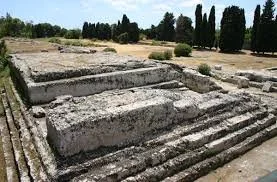
The Ara of Hieron II is easy to overlook because much of it now survives only at ground level, but its scale was astonishing.
Built in the 3rd century BC under King Hieron II, this massive altar was likely used for large public sacrifices during religious festivals. It stretched nearly 200 meters in length, making it one of the largest altars of the ancient world.
Ancient accounts describe enormous ceremonies here involving hundreds of bulls sacrificed at once during important celebrations (every year, 450 bulls were sacrificed in honor of Zeus). The sheer size of the altar gives insight into both the wealth and religious ambition of ancient Syracuse.
Ortigia
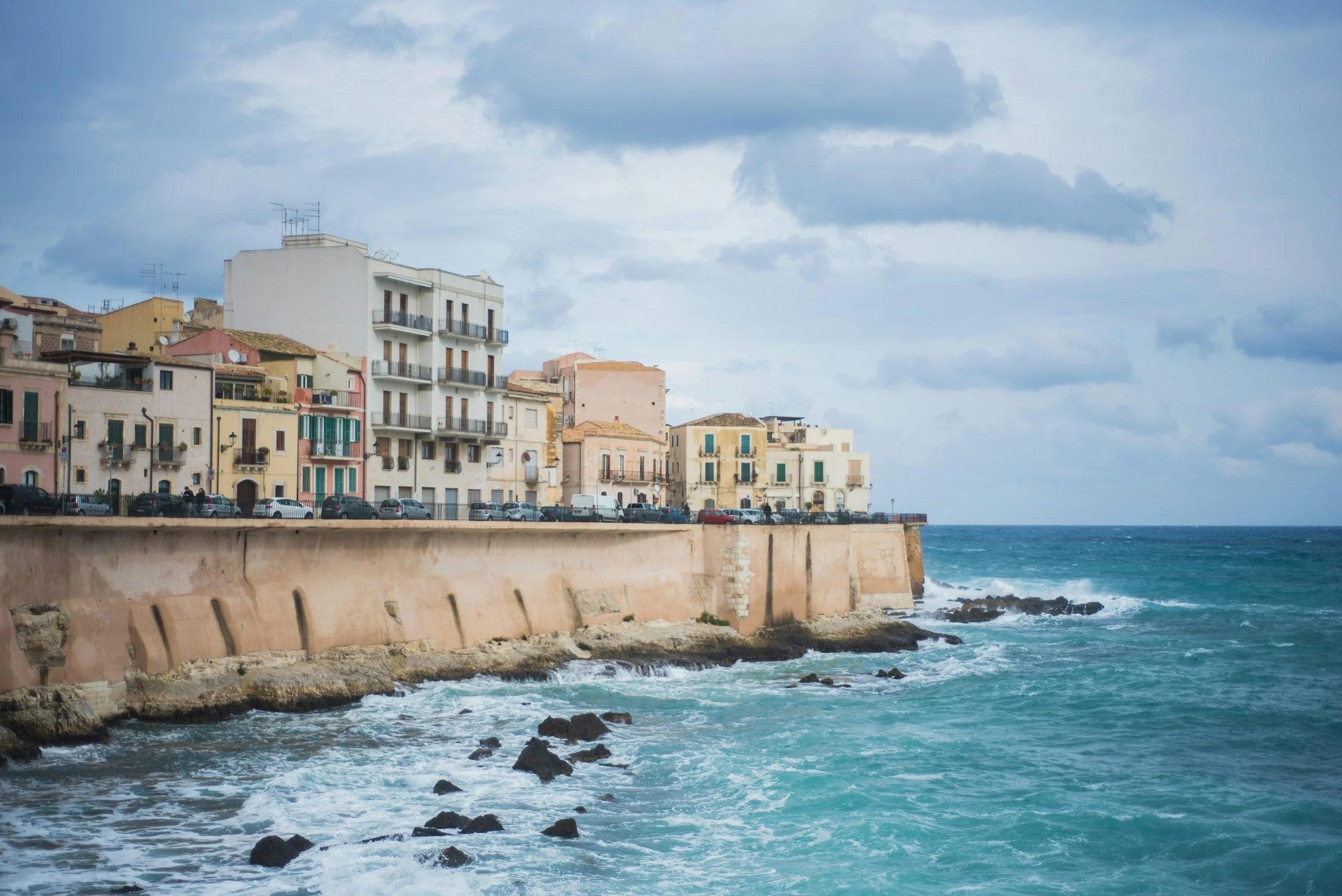
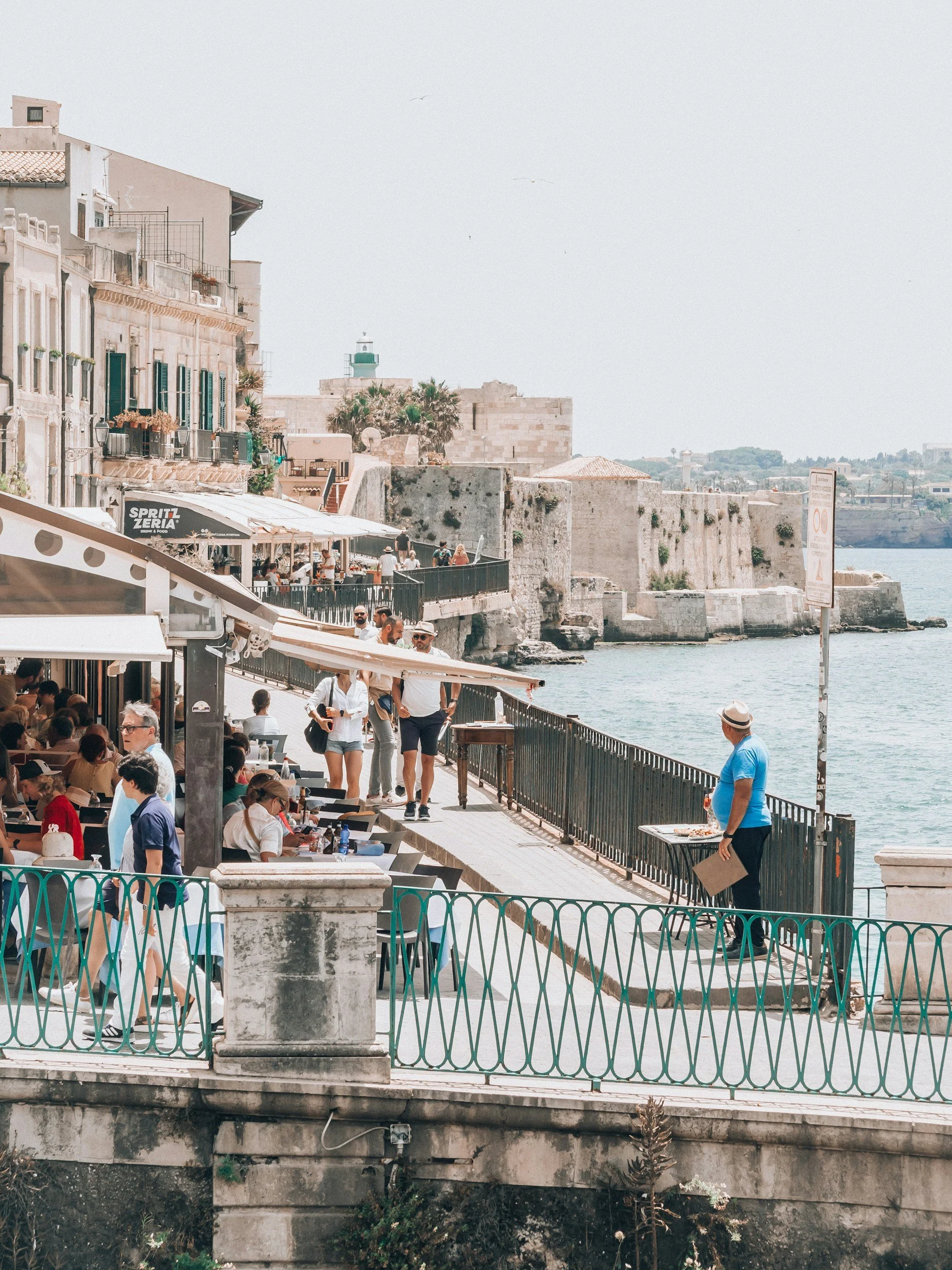
After exploring the ancient world, we move into the living heart of Syracuse: the island of Ortigia.
Connected to the mainland by bridges, Ortigia is the historic center of Syracuse and one of the most atmospheric places in Sicily. Here, ancient ruins, Baroque architecture, markets, cafés, and everyday Sicilian life all exist side by side.
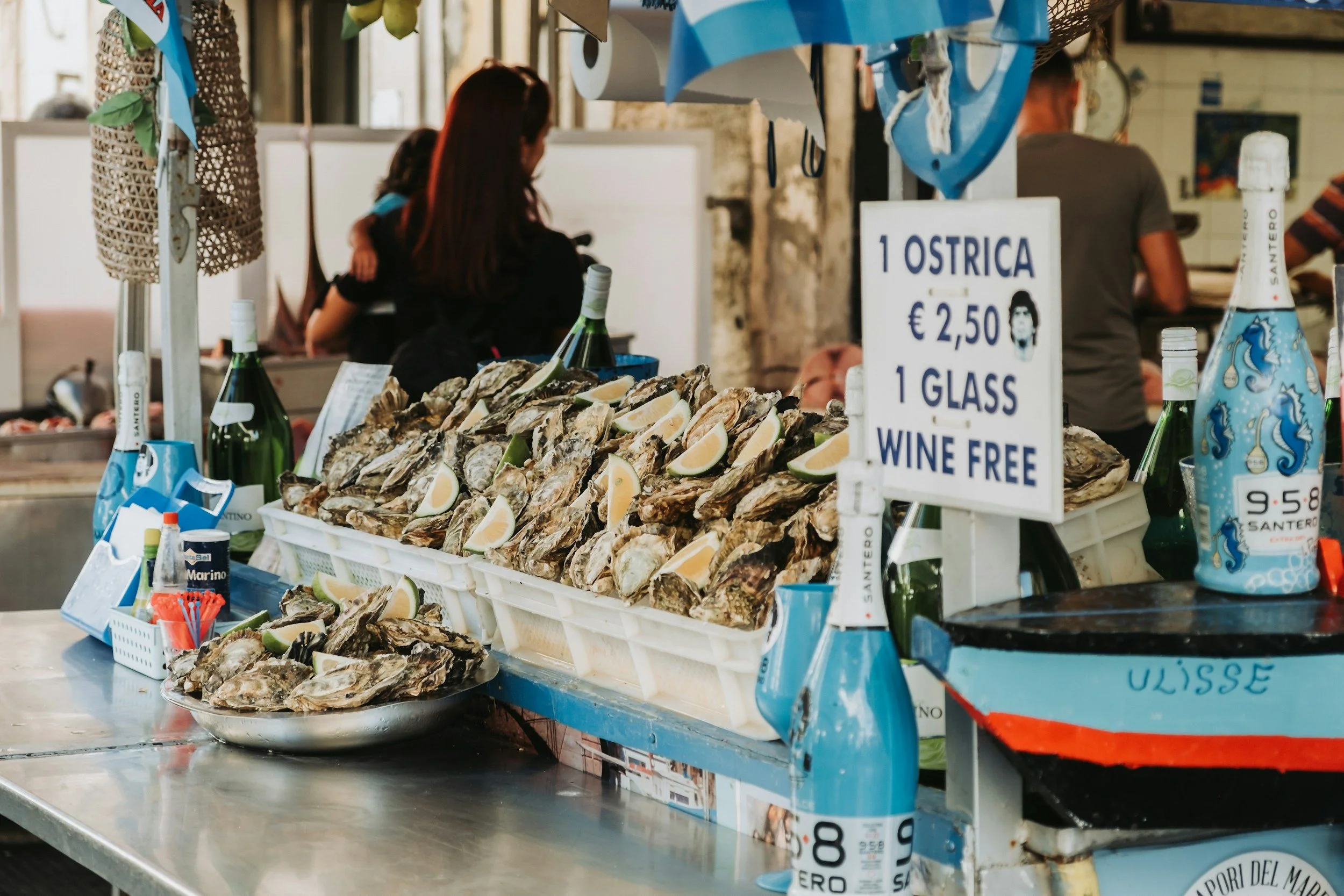
The Ortigia Market is one of the best places to experience modern Sicilian culture through food.
The market is loud, colorful, chaotic, and deeply local. Vendors shout prices across narrow lanes while selling seafood, tomatoes, citrus, pistachios, spices, cheeses, olives, and fresh bread. The Arab influence on Sicilian cuisine becomes very visible here — especially in the spices, citrus fruits, and sweets.
This is not a staged tourist market. Many locals still shop here daily, and it captures the social energy that defines so much of Sicilian life.
Temple of Apollo
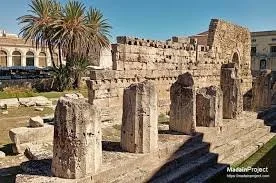
The Temple of Apollo sits almost unexpectedly in the middle of the city.
Dating to the 6th century BC, it is considered one of the oldest Doric temples in Sicily. Over the centuries, it has been transformed many times: from pagan temple to Byzantine church, then to a mosque during Arab rule, then back into a Christian church under the Normans.
Few places illustrate Sicily’s layered history so clearly. The structure itself became a reflection of the many civilizations that ruled the island.
Piazza del Duomo & Syracuse Cathedral
The stunning Piazza del Duomo is often considered one of the most beautiful squares in Italy.
Warm limestone buildings glow gold in the Sicilian sunlight, especially in the late afternoon and evening. The square feels elegant yet relaxed, with cafés spilling into the open space and locals slowly passing through during the evening passeggiata.
At the center stands the remarkable Syracuse Cathedral.
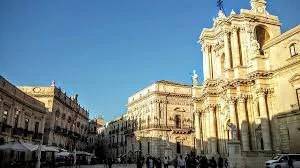
What makes this cathedral extraordinary is that it was built directly around an ancient Greek temple dedicated to Athena. If you look closely at the cathedral walls, you can still clearly see massive Greek columns embedded within the later Baroque structure.
Very few buildings in the world so visibly contain multiple civilizations within a single structure: Greek temple, Christian church, Norman influence, Baroque reconstruction — all layered together over nearly 2,500 years.
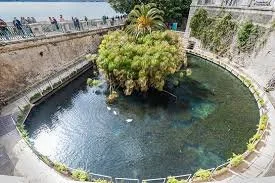
Fountain of Arethusa
Near the sea lies the Fountain of Arethusa, one of the most famous natural springs in Sicily.
According to Greek mythology, the nymph Arethusa fled here from Greece while escaping the river god Alpheus. The goddess Artemis transformed her into a freshwater spring, which still flows today only a short distance from the sea.
The fountain is also unusual because papyrus plants grow here naturally — one of the very few places in Europe where they do.